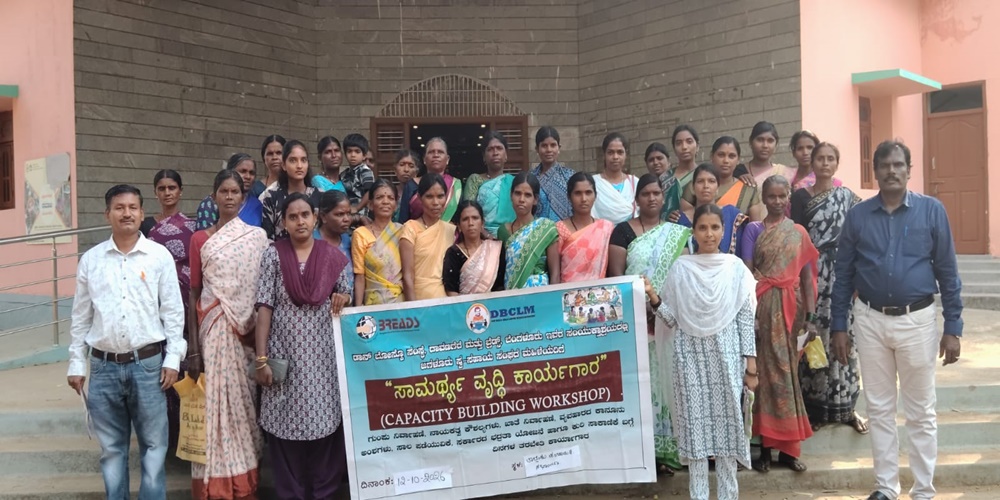
Empowering Women, Transforming Livelihoods: We Live Project Launches Three-Day Sheep Rearing Workshop
Date: 12-14th October 2026
District: Jagaluru, Davanagere
In a significant step toward rural women's empowerment and sustainable livelihood development, the We Live Project organized a three-day Sheep Rearing Workshop at the Taluk Panchayat Office, Jagaluru. The programme brought together 30 Self-Help Group (SHG) women from various villages of Jagaluru Taluk, selected as beneficiaries of the sheep rearing initiative.
The workshop was designed to equip participants with practical knowledge and skills in sheep rearing while fostering unity, financial discipline and entrepreneurship among rural women. Through interactive sessions and discussions, the women learned how livestock farming can become a reliable source of income and a pathway towards greater economic independence.
The inaugural programme was graced by Mr. Kenchappa, Education Officer, Taluk Panchayat, Jagaluru; Mrs. Vishalakshi, ASHA Worker, Jagaluru; Mr. Jayappa, NRLM Project Member, Jagaluru; and Rev. Fr. Regi Jacob, Director, DBCLM, Davanagere.
Their encouraging words motivated the participants to actively engage in the training and make the best use of the opportunities provided through the project.
Over the course of three days, the participants were introduced to essential aspects of sheep rearing, including the selection of healthy breeds, feeding practices, healthcare management and sustainable livestock management techniques. Special emphasis was placed on the importance of collective action, mutual support and effective functioning of Self-Help Groups.
Beyond livestock management, the workshop also focused on developing the habit of regular savings, financial planning and accessing government welfare schemes available for women. These sessions empowered the participants with valuable information that can help improve their socio-economic conditions and strengthen their families' financial security.
The training served as more than a capacity-building programme. It became a platform where women shared experiences, built networks of support and strengthened their confidence to take up income-generating activities. By combining knowledge, collaboration and opportunity, the workshop laid the foundation for long-term livelihood enhancement and community development.
Through initiatives like the We Live Project, Don Bosco continues its commitment to empowering rural women, promoting self-reliance and creating sustainable pathways for economic growth and social transformation.
"When women are empowered with knowledge, skills and opportunity, they become catalysts of change for their families and communities."
Back